Journal · Painting
When Everyday Life Becomes a Painting
A city under rain. A brief moment before a mirror. A room with no one in it. Painting often begins not with something extraordinary, but with a closer look at what we usually pass by.
The Ordinary as Subject
Not Every Subject Needs to Be Rare
Most everyday scenes have no clear beginning or end. People walk past, close a door, adjust their hair, leave a room. We catch it out of the corner of an eye and move straight on to something else. A painting does the opposite: it holds one moment still and gives it time.
The subject itself can be modest. What matters is how the artist builds the space around it — what gets left outside the frame, where we’re allowed to come close, and where we’re kept at a distance. An ordinary scene stops feeling neutral once traces of the period, of habit, of someone’s presence begin to surface within it.
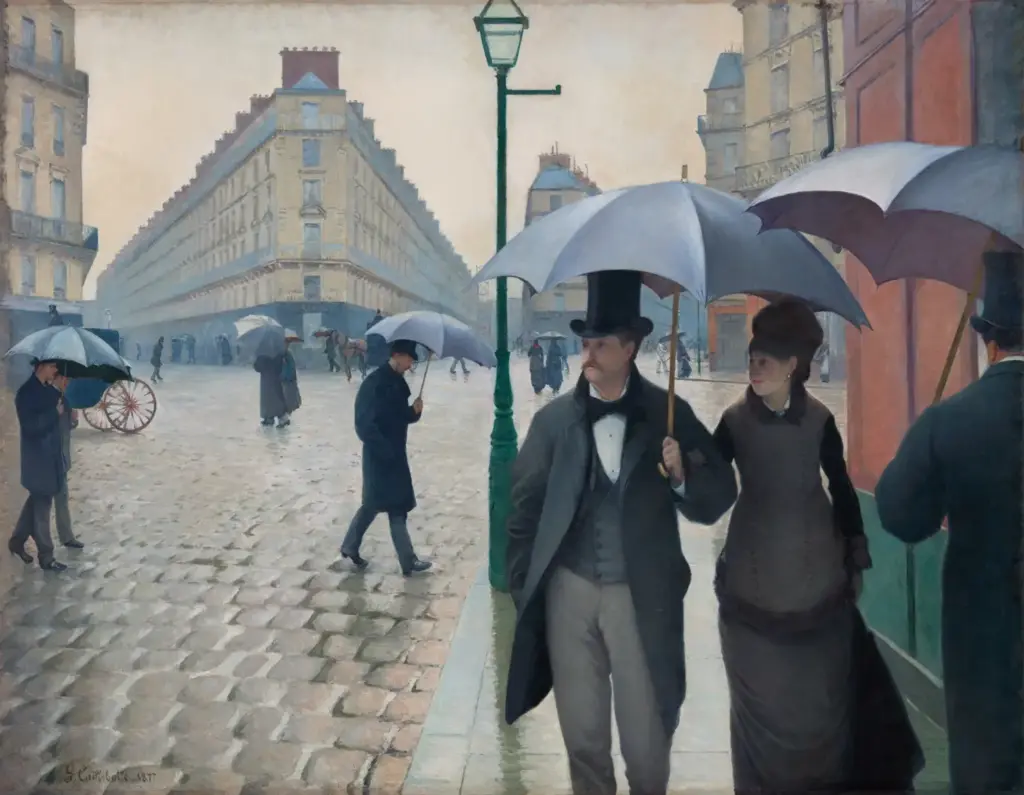
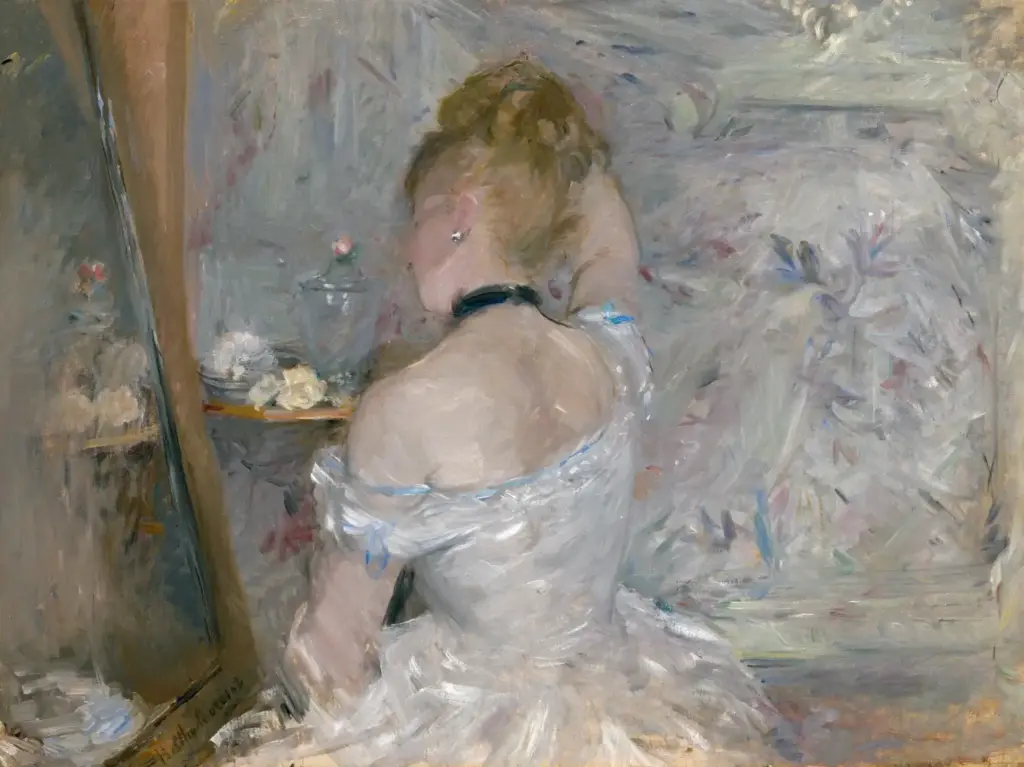
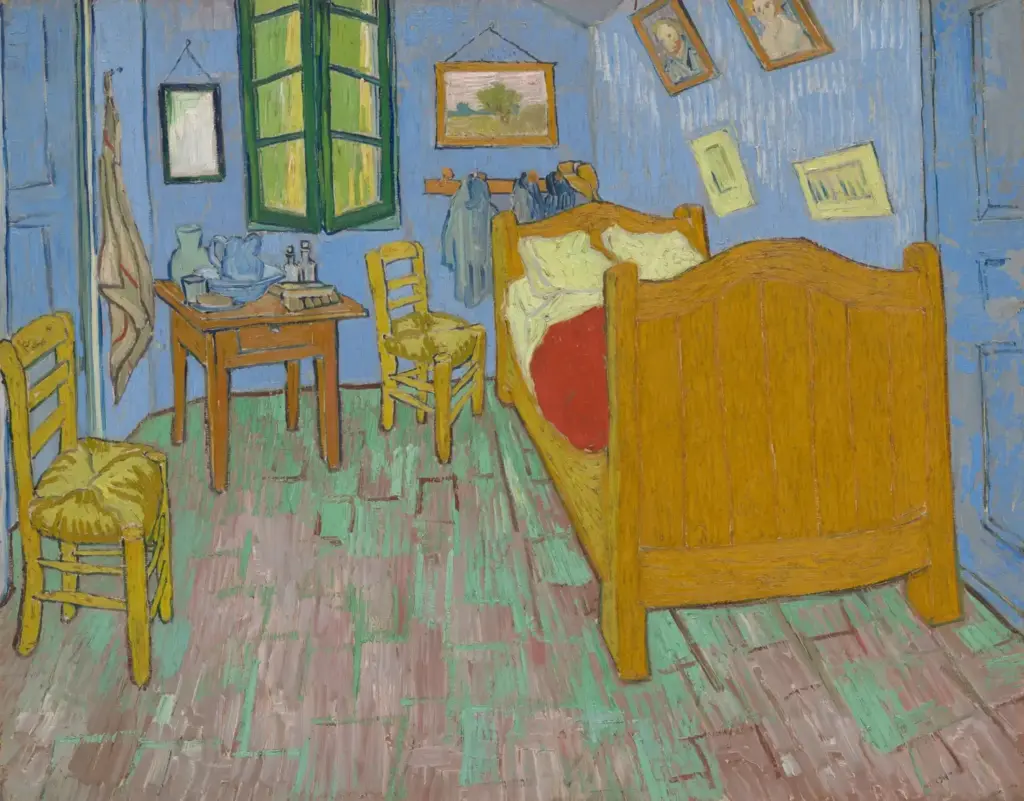
The three paintings below have little in common on the surface. One opens onto a wide Parisian intersection, another puts us in a private room with a woman at her toilette, and the third does without a figure altogether. Yet in each, the ordinary — once it passes through the artist’s attention — becomes an image worth returning to.
The Main Idea
A Small Moment Can Carry a Large Theme
Wet cobblestones, the turn of a wrist, an empty chair — none of these explain anything on their own. In a painting, though, they become part of its rhythm, its space, its mood, which is exactly what makes them stay with us.
Three Different Scenes
A City, a Private Room, and an Empty Interior
These three works share no single style. Each handles space, colour, and human presence differently, but all three grow out of a scene that would have been easy to walk straight past.
A Closer Look
How an Ordinary Scene Takes On Character
Each of the three paintings holds our attention through a different device: a sweeping urban perspective, the quiet of a private gesture, or a presence felt through the objects someone uses every day.
01
Gustave Caillebotte
A City Where No One Stops
A couple in the foreground seem about to walk right past us; a man on the right has already half-stepped out of the frame, and further back the crowd scatters in different directions. The wet cobblestones hold the light, and a lamppost splits the composition almost in two. The passers-by share the same street, yet each is clearly headed somewhere else. The rain matters here not just as weather — it changes how people move and sets the pace of the whole scene.
02
Berthe Morisot
A Moment That Needs No Explanation
The woman sits with her back to us, one hand raised toward her hair. Her face is barely visible, the mirror gives back no clear reflection, and the room dissolves into loose, pale brushwork. This doesn’t read as a pose arranged for a viewer but as a private moment caught after the fact. The painting doesn’t insist on anything or hint at what she’s thinking — it simply lets us stay near her for a few minutes.
03
Vincent van Gogh
A Room With No One In It, Where Someone Is Still Felt
There’s no figure in The Bedroom, but the space still carries traces of whoever lives there. The bed is made, the chairs are set as though used every day, and paintings hang on the walls. The tilted perspective and saturated colour turn these plain objects into something close to characters in their own right. The person is present not in the frame, but in how the room has been arranged.
A Slower Look
A Painting Opens Up When We Don’t Rush to Explain It
Looking closely at a painting doesn’t require knowing art history by heart. Sometimes it’s enough to stay in front of a work a little longer and notice how it’s built.
- Where does your eye land first — and what leads it there?
- What does the artist render clearly, and what stays on the edge of visibility?
- Is a human presence felt even when no one appears in the frame?
- Which detail keeps a scene from feeling generic and makes it specific and alive?
One Useful Habit
Start by Naming What You Actually See
The distance between two people, the turn of a wrist, the tilt of a chair, the colour of a wall, light on wet stone. A plain description like this often opens up a painting better than a quick, sweeping judgment.
Beyond the Subject
Everyday Doesn’t Mean Unimportant
These three works share no single style or mood. Caillebotte builds a wide urban space with sharp perspective and figures that seem casually cropped by the canvas edge, while in Morisot forms dissolve into the pale surface of the paint rather than being sharply defined. Van Gogh keeps his room recognisable without holding it to ordinary accuracy.
What connects them is an attention to life that carries on without ceremony. The street wasn’t waiting for the artist. The woman at the mirror isn’t addressing us. The room stays a room. And yet, once each scene had passed through the artist’s eye and hand, it stopped being accidental.
This may be one of painting’s quieter powers: it doesn’t always show us a world we’ve never seen. Sometimes it hands back one we already know — only now it’s harder to walk past without looking.
Sources and Image Rights
Museum Records
Artist names, titles, dating, materials, dimensions, and collection details have been checked against the individual object pages at The Art Institute of Chicago:
Paris Street; Rainy Day
Woman at Her Toilette
The Bedroom
The museum has designated these images CC0 Public Domain, which allows the digital reproductions to be used without separate permission; captions here retain the artist’s name, title, date, and museum for each work.