Glazed ceramic · 2024
Singing Rooster
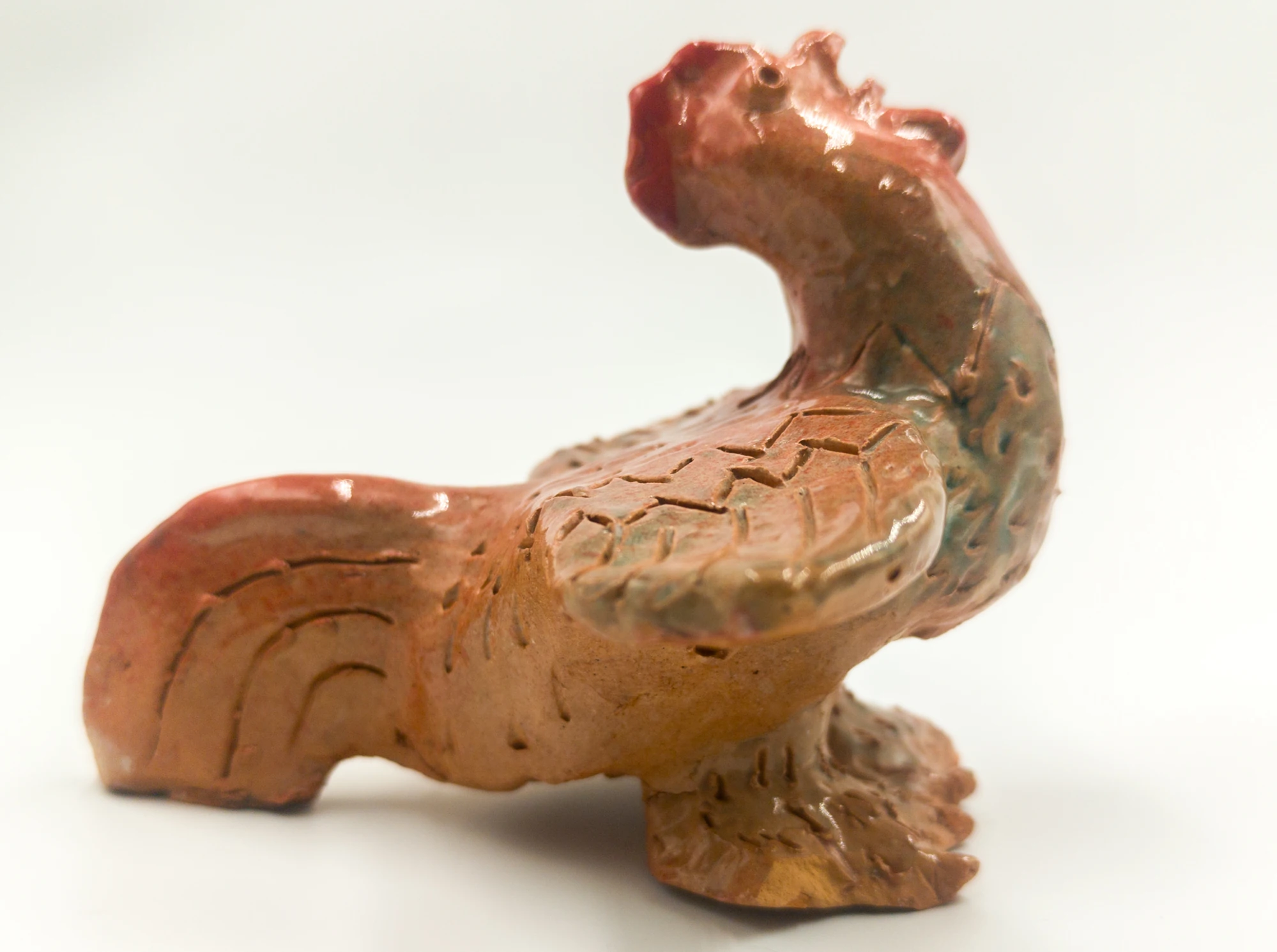
This ceramic work by Slava Romanenko captures a rooster in the act of crowing: its head is tilted back, its beak is open and its wings extend almost horizontally. The expressive pose is supported by a carefully resolved structure, with reinforced wing joints and a tail that helps keep the figure balanced.
| Artist | Slava Romanenko |
| Year | 2024 |
| Materials | Fired clay, ceramic glaze |
| Dimensions | 14 × 18 × 16 cm height × width × depth |
Movement, voice and balance in a single form
About the Work
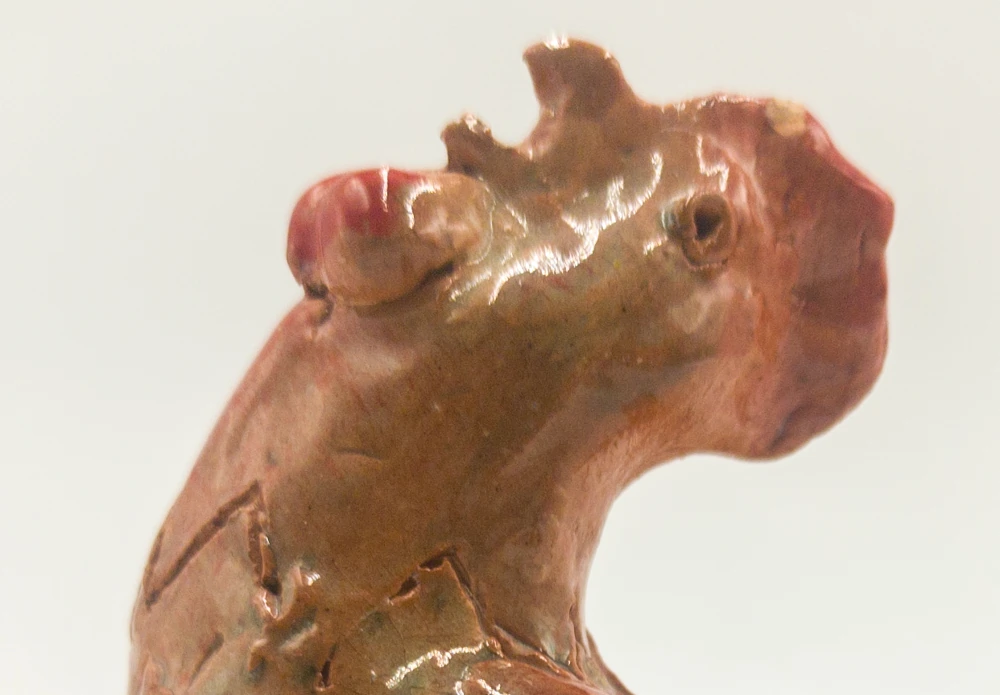
Singing Rooster is built around a strong sense of movement. The lifted, backward-tilting head, open beak and widely extended wings capture the moment when the bird seems to draw breath and crow. This gives the small ceramic figure a dynamic presence from several angles.
The horizontal wings broaden the silhouette, while the curved neck directs the eye upward. The tail carries the form backward and also touches the surface, counterbalancing the head. In this way, the rooster’s descriptive features also become structural elements on which the stability of the entire work depends.
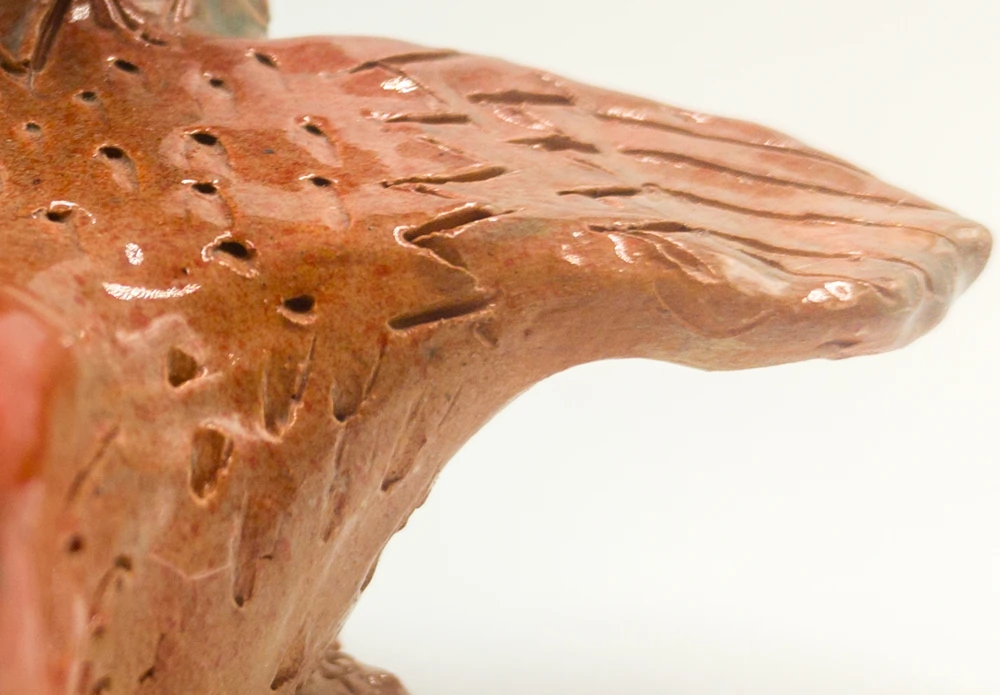
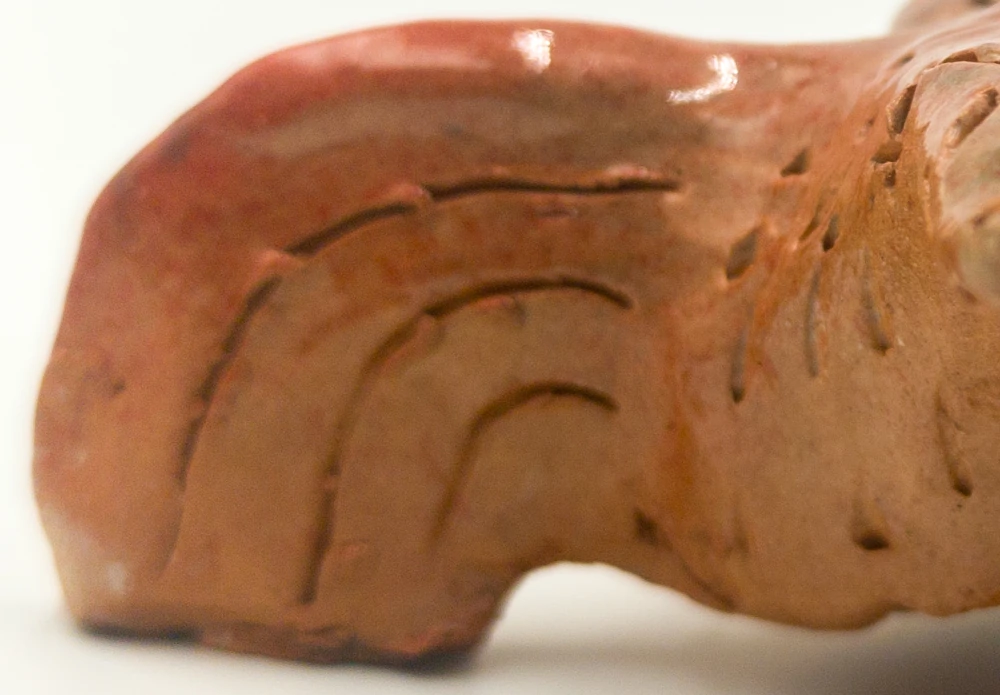
The surface was worked by hand: incised lines, grooves and cuts suggest feathers across the body, wings and tail. The glaze brings out the relief and combines warm terracotta, reddish and muted green tones while allowing the lively texture of the hand-built clay to remain visible.
Exhibition history
The work was made for an exhibition. During the exhibition, part of the glaze was chipped from the comb and a small section of one leg was broken off. The photographs present the work in its current condition, without concealing these traces of its exhibition history.
Structural solution
Built without a wire armature
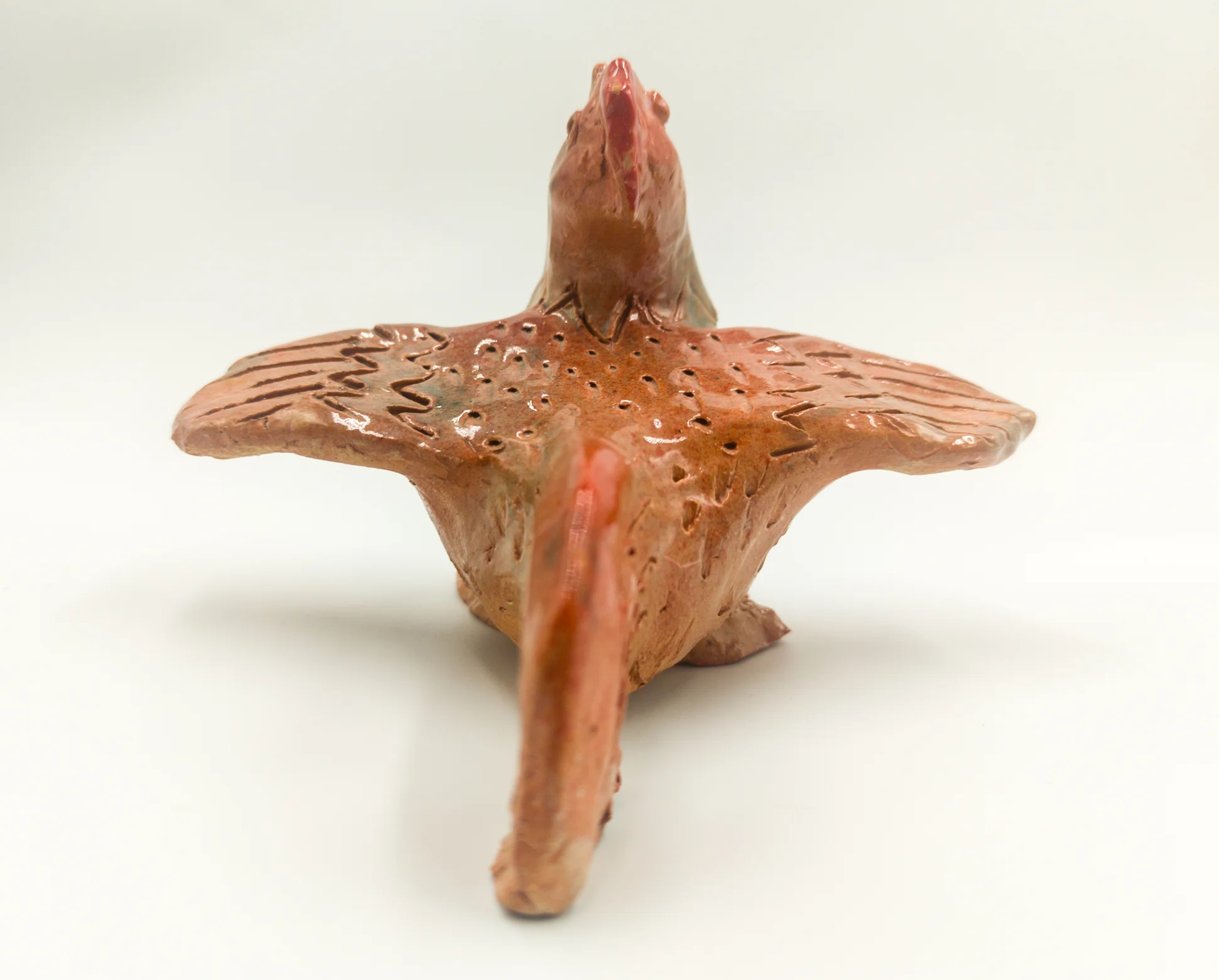
Wire could not be used as an internal armature in the class. To prevent the long horizontal wings from bending or breaking while the clay was wet, Slava added more clay where each wing joins the body. Because the backward- tilted head shifted the centre of gravity, the tail became an additional point of support.
Outstretched wings, a tilted head and a supporting tail
Views
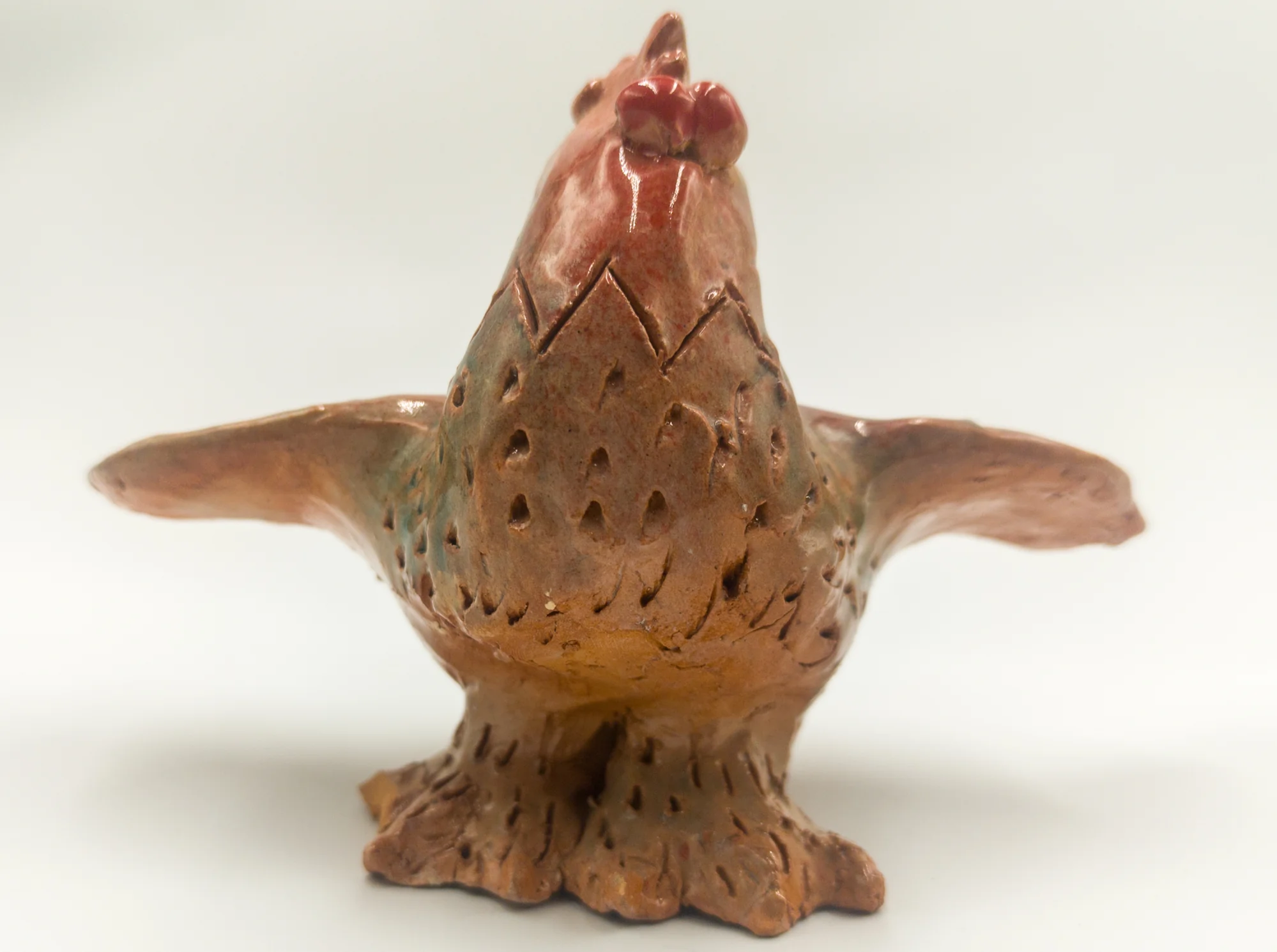
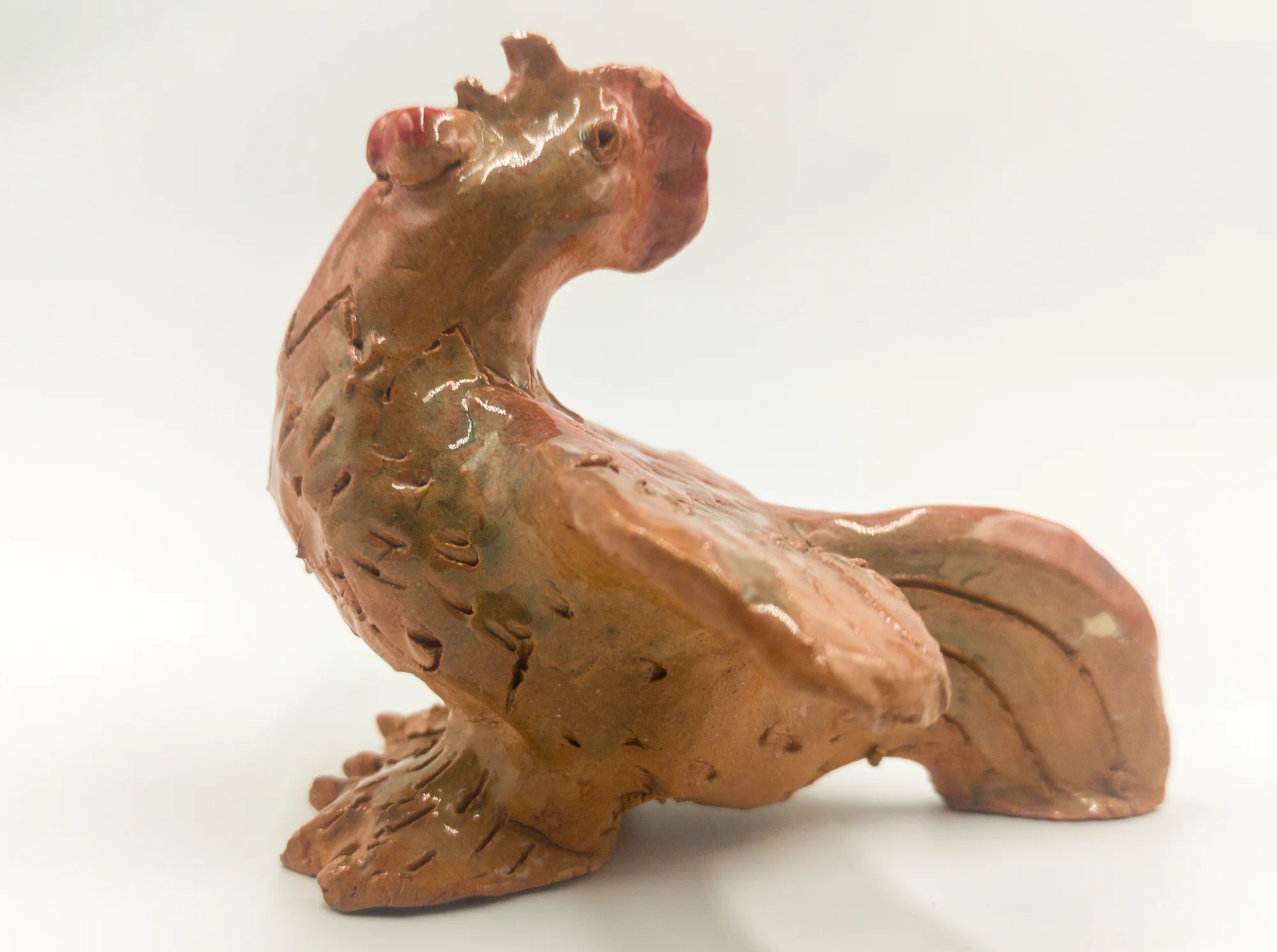
Photographs from several sides show how the ceramic rooster’s silhouette changes with the viewpoint. The front view emphasises the wingspan, the side views reveal the curve of the neck and the backward pull of the pose, and the rear view shows how the wings join the body and how the tail contributes to the figure’s overall balance.
Head, wing joint and supporting tail
Details
Close-up views reveal the open beak and backward-tilting head, the hand-cut lines and grooves used to suggest feathers, the thickened wing joint and the broad tail that reaches the surface to support the figure. Variations in the modelling and the movement of the glaze preserve the work’s handmade character.
A rotating view of the silhouette and structure
Video Overview
In the video, Singing Rooster turns slowly, allowing the viewer to follow the backward-tilting head, horizontal wings, hand-worked feather texture, glazed surface and the tail that supports the rear-weighted pose.
From wet clay to a stable ceramic form
Process
The most difficult challenges were keeping the wings horizontal and balancing the figure with its head tilted far back. Slava resolved both through the construction of the clay itself, without a wire armature.
01
Class context
Made in a Ceramics Class
Slava created the rooster in 2024 during Ceramics and Pottery classes at the Kyiv Palace of Children and Youth, under the guidance of Yuliia Kopylova.
02
Wing construction
Keeping the Wings Horizontal
While the clay was wet, the long outstretched wings could bend under their own weight or break away. Because a wire armature was not allowed in the class, Slava thickened the wing bases and added more clay where they join the body.
03
Balance
The Tail as an Additional Point of Support
The rooster’s head leans far back, shifting the centre of gravity of the entire figure in the same direction. To keep the work stable, the tail was extended down to the surface, becoming not only part of the image but also an additional support.
04
Ceramic process
Two Firings and Glazing
After the modelling was complete, the work received its first firing. The surface was then coated with ceramic glaze and fired again, fixing the glaze and giving it its characteristic colour and sheen.